Building the Product and Design Foundation of an AI Startup
A design leadership engagement focused on product strategy, user experience,
branding, design operations, and organizational alignment for an early-stage
local AI company.
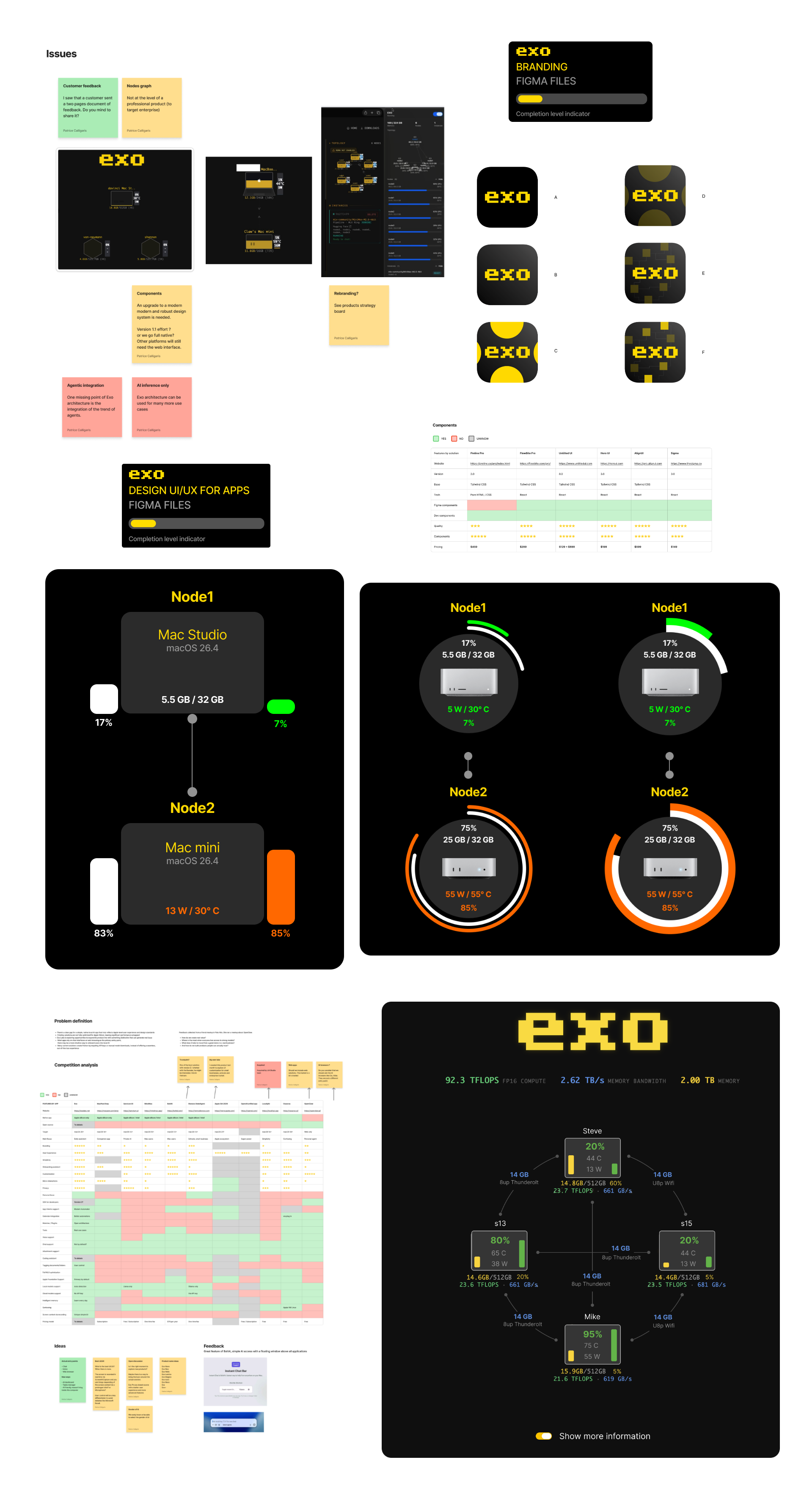
NOTE: Only a sneak peek of my work is shown at the bottom of this page due to the NDA.
Highlights
Engagement as Design Lead.
Defined product strategy and roadmap.
Led branding initiative with an internationally recognized agency.
Created design system strategy.
Built product vision and competitive research.
Collaborated with leadership, engineers, and strategic partners.
Overview
In early 2026, I joined Exo Labs as its Founding Design Lead after initially
approaching the company as a potential design consultant. During the
few months, my role quickly expanded far beyond interface design. I helped
shape product strategy, user experience, branding, design operations, project
management, competitive research, and long-term product vision.
Although the engagement ended earlier than expected, it remains one of the most interesting design leadership experiences of my career. We built a strong strategic foundation before the company had to pause our collaboration due to unexpected operational challenges while it was still operating from the UK and working through its organizational transition.
The Background
I first discovered Exo Labs while working at MacWeb. At the time, I immediately
saw potential synergies between both companies and introduced their CEOs to
explore possible business opportunities.
After leaving MacWeb, I spent more than a year exploring SwiftUI and modern
native Apple development. Once that exploration was complete, I revisited Exo
Labs to see how the company had evolved.
The progress was impressive. For the first time, the platform had moved beyond
a command-line interface and introduced a graphical user interface. After
testing the product, I immediately recognized the potential of local AI and
distributed inference, while also identifying opportunities to improve usability,
onboarding, product positioning, and the overall user experience. I introduced a variety of product and user experience improvements that resonated strongly with the founder. Recognizing the strategic value of my contributions, he sent an official offer for me to join the company, an opportunity I was excited to accept.
The Challenge
Exo Labs had exceptional engineering talent and a technically ambitious vision.
However, like many early-stage startups, several important foundations were
still missing.
Transform a technically complex product into an accessible experience.
Build a scalable design system.
Define a long-term visual identity.
Improve collaboration across disciplines.
Establish product management processes.
Better understand the competitive local AI landscape.
Position the company against rapidly evolving competitors.
My Contributions
Product Strategy
I researched the rapidly evolving local AI ecosystem, analyzed competing
products, documented their strengths and weaknesses, and identified
opportunities where Exo Labs could clearly differentiate itself.
Using FigJam, I created collaborative strategy boards mapping competitors,
feature comparisons, user journeys, and future opportunities.
User Experience
After extensively testing the platform, I documented friction points throughout
the user experience and proposed improvements covering onboarding, interface
consistency, workflows, information architecture, feature discoverability,
and long-term usability. My feedback and product ideas were well received across the team, and I was recognized for introducing collaborative design workflows in Figma that improved communication and alignment.
Design Operations
I created a structured Figma environment to establish a foundation for future
design work, including organized files, collaborative whiteboards,
documentation, exploration spaces, and planning assets. It was a valuable opportunity to establish the right foundations and build effective processes from the start.
Design System
One of the key challenges was defining the long-term direction of the product's design system. The team was evaluating two possible approaches: maintaining a hybrid experience that combined native and web UI components, or transitioning to a fully native interface. To support this decision, I researched industry-leading design systems, documented their strengths and trade-offs, and created a comprehensive FigJam board to facilitate discussions and align stakeholders. While a final decision had not yet been made during my engagement, the research established a solid foundation for future product evolution.
AI Workflow
One of the challenges was defining how AI should fit into the team's design workflow. While I had extensive experience using tools such as Cursor and Codex to accelerate product design and development, the engineering team primarily relied on Claude Code. Bridging these different workflows, and integrating AI effectively into collaborative design processes, proved to be an ongoing challenge.
More broadly, this reflects an industry-wide issue. Although AI coding assistants have matured rapidly, collaborative AI workflows for designers are still evolving. Most tools excel at individual productivity but fall short when it comes to shared ideation, design reviews, documentation, and real-time collaboration across cross-functional teams.
Throughout the engagement, I explored different approaches and identified opportunities where AI could enhance research, product strategy, design documentation, and communication. Establishing a cohesive AI-powered design workflow remains one of the most important opportunities for modern product teams.
Project Management
The team faced typical early-stage operational challenges and had yet to establish formal product management workflows.
After evaluating several platforms, I recommended adopting Linear, which gave
the team a modern workflow better suited to a fast-moving startup. Implementing new project management tools like Linear was difficult due to the engineering team's established reliance on GitHub and the fast-paced environment. While the broader rollout didn't succeed, I used Linear to organize the product strategy and create a clear roadmap for future initiatives.
Brand Strategy
I helped define the company’s long-term brand direction and led the search
for an external branding partner. After contacting multiple agencies, I
recommended selecting a Spanish studio, with whom we collaborated for several
weeks on a stronger visual identity. I enjoyed working with Dmitry Lepisov's internationally recognized branding team, and it was an outstanding experience. Unfortunately, I can't share the results of our collaboration due to a confidentiality agreement (NDA).
Cross-Team Collaboration
I collaborated closely with leadership, engineers, external partners, and potential strategic collaborators. These conversations uncovered promising business opportunities and helped align design decisions with the company's broader strategic vision. Along the way, I had the opportunity to meet inspiring teams at Z.ai and Osaurus AI, further expanding my perspective on the rapidly evolving local AI ecosystem. I also discovered great solutions like oMLX and WebAI.
Results
Established the foundation for scalable design collaboration.
Collaborative strategy documentation.
Identified key market opportunities and product differentiators.
Helped define priorities during a period of rapid company growth.
UX recommendations for onboarding and usability.
A long-term design system strategy.
Introduced a structured approach to product planning.
A refreshed branding initiative.
Clearer alignment between product, design, and leadership.
What I Learned
This engagement reinforced my belief that successful design leadership extends far beyond interface design. It requires aligning product vision, engineering, branding, and business strategy around a shared direction.
Great design leadership creates alignment. They establish processes. They connect
engineering, business, marketing, and product strategy. They simplify
complexity and help organizations make better decisions.
Although the engagement concluded earlier than expected due to unexpected
operational challenges, I remain proud of the work accomplished
and grateful to have collaborated with an exceptionally talented team tackling
ambitious technical problems.
UPDATE
Local.ai website is now online. This new project created by Exo Labs also helps explain why my collaboration with the team was stopped few months ago. The collaboration ended because the company made a strategic pivot to focus all resources on launching a new solution, which deprioritized the design role for that phase. Priorities can change rapidly in a startup, and that is part of the startup journey.
Only a sneak peek of my work is shown below due to the project's non-disclosure agreement (NDA).